
Play Neon Rush Online Free
Platformer Games
Neon Rush





| Rating | 4.5 / 5 (35,000 votes) |
| Played | 350,000 times |
| Developer | AZ Games |
| Released | 2025-05-20 |
| Platform | Desktop, Mobile, Tablet |
| Technology | HTML5 |
| Category | Platformer Games |
Most rhythm platformers look like their soundtrack matters. Neon Rush is built so it actually does — the obstacles aren't decorated with the music, they're choreographed to it, and the players who treat the beat as noise are the players who stay stuck on level two.
What this guide covers:
- What is Neon Rush?
- How to Play Neon Rush Unblocked
- Neon Rush Controls
- Playing With Your Ears
- Neon Rush Tips
- Games Like Neon Rush
- Neon Rush FAQ
What is Neon Rush?
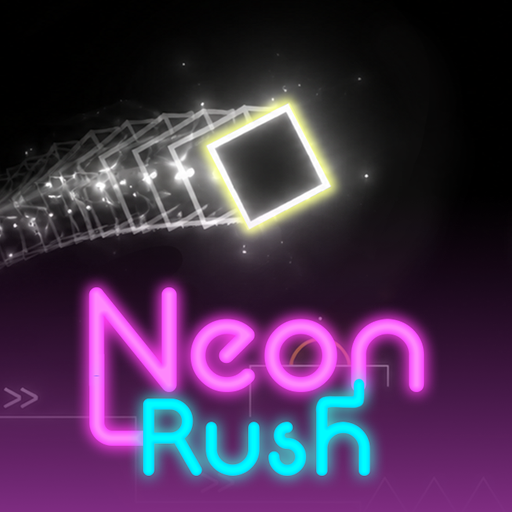
Neon Rush is a rhythm-based 2D platformer: a glowing cube that never stops moving forward, obstacle courses that pulse in time with the soundtrack, and one input — jump — pressed at the moments the music demands. If you know Geometry Dash, you know the school; Neon Rush is that formula distilled to its purest neon elements.
The aesthetic isn't just mood lighting. Every hazard glows against the dark background, and everything that can hurt you moves on the beat — spikes rise on downbeats, barriers sweep across on the phrase, platforms blink in and out in time with the melody. The result is a game where reading the level and hearing the level are the same skill. Dense sections that look impossible at first glance become navigable the moment you stop watching for obstacles individually and start feeling the pattern the music is spelling out.
Structurally it follows the classic rhythm-platformer arc: early levels with single hazards and generous spacing, escalating to stages where hazards stack into sequences — jump, land on a moving platform, jump again — with timing windows measured in fractions of a beat. Death is instant, restarts are immediate, and every level is a fixed, learnable composition. You don't beat Neon Rush levels with reflexes. You beat them the way you learn a song.
How to Play Neon Rush Unblocked
The cube auto-runs; you tap to jump. That's the entire interface, and the game spends all of its levels exploring what one well-timed input can mean.
The progression of skill in Neon Rush is really a progression of attention. New players watch the cube. Intermediate players watch the obstacles. Good players watch neither — they've stopped parsing the screen object-by-object and started playing the rhythm, letting the beat schedule their inputs the way a drummer reads a chart rather than counting individual notes.
Concretely: every level is a fixed sequence, so every death is a curriculum. The practical loop that works — the same one the Geometry Dash community has refined for a decade — is to let yourself die through a new section a few times while listening, without even trying hard to survive. You're letting the music attach itself to the obstacle pattern. Then attempt it for real, and you'll find your fingers already know things your eyes hadn't worked out yet. It feels like cheating. It's just how rhythm games are meant to be played.
The difficulty arrives on schedule. Once single obstacles are comfortable, the game starts chaining them so that one jump must set up the next — landing spots that are only safe for half a beat, moving platforms that require you to jump from them at the exact moment they pass under the next hazard. At that tier, hesitation and reflex both fail; only rhythm carries you through.
Neon Rush Controls
| Action | Desktop | Mobile |
|---|---|---|
| Jump | Space / Up Arrow / Click | Tap anywhere |
| Higher jump arc | Hold slightly longer | Longer touch |
| Short hop | Quick tap | Quick tap |
| Restart | Instant, automatic | Instant, automatic |
Note the arc control — a short hop and a held jump clear different gaps, and later levels are specific about which one they want. Half the "impossible" jumps in Neon Rush are just hop/jump mix-ups.
Playing With Your Ears
This deserves its own section, because it's the single biggest jump in skill available to any Neon Rush player.
Your visual reaction time — see thing, process thing, move finger — runs somewhere around a quarter of a second. That's an eternity at the speeds this genre runs. Your auditory timing, though, is far more precise: humans subconsciously lock onto a beat and can time actions to it with accuracy measured in tens of milliseconds. Rhythm platformers are built on exactly this asymmetry. The obstacles sync to the music because your ears are the faster instrument.
So the technique: on any section that keeps killing you, stop looking at the obstacles entirely. Close your eyes for one attempt and just listen — find the beat, notice where the "hits" (the moments something would have killed you) land in the measure. Then play the section watching the screen but tapping to the rhythm you already know, letting the visuals confirm rather than decide. Almost every player clears their wall section within a few attempts of making that switch. The level was composed this way on purpose; playing it by ear isn't an exploit, it's the intended instrument.
The flip side: sound matters, so environment matters. Neon Rush is considerably harder on mute, through tinny laptop speakers, or with the game buried in a browser tab where audio stutters. Headphones on, volume up, tab focused. It's rare that a gaming guide can honestly say "better sound = better score," but here it's simply true.
Neon Rush Tips
1. Learn sections with your eyes half-closed
As above — sacrifice a few runs to pure listening. The pattern the music teaches you is the pattern your fingers need.
2. Look two obstacles ahead
Your cube never moves on screen, so watching it is watching a fixed point. Keep your focus ahead of where you are; each jump should already be decided before the obstacle arrives under you.
3. Count the hard sequences out loud
"One-and-two-and-jump." Verbalizing forces your brain to encode the timing as rhythm rather than reaction, and spoken counts don't panic the way silent ones do. Every music teacher in history was right about this.
4. Full runs, not just the wall
Once you can clear your problem section in isolation, immediately string full runs together. Arriving at a hard section with the rhythm of the easier parts still in your hands is part of beating it — isolated practice teaches timing, full runs teach consistency.
5. Manage the frustration spike
Rhythm games have a failure personality: you'll clear a wall, feel brilliant, then die to something trivial from sheer excitement. When the run after a breakthrough crashes early, that's adrenaline, not skill loss. Breathe once, restart, pick the rhythm back up.
Games Like Neon Rush
For more rhythm and precision, from our platformer games collection:
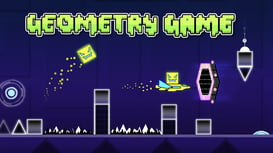
- Geometry Dash — The undisputed classic of the genre and Neon Rush's closest relative.
- Geometry Arrow — This site's flagship: wave-mode flying through spike corridors, six handcrafted levels.
- Shape Rush — The same one-button DNA with the music dialed back and the obstacle courses dialed up.
- Vex 3 — Multi-input precision platforming when one button starts feeling roomy.
- Tap Road — Rhythm-trained fingers translate directly to its neon dodge patterns.
- Tunnel Rush — For when the trance breaks and you want pure visual speed.
Neon Rush FAQ
Is Neon Rush free to play?
Yes — Neon Rush is completely free in your browser. No download, no account, no payments, no locked levels.
Is Neon Rush unblocked at school?
Yes. Neon Rush is available on this site as an unblocked HTML5 game — it runs on Chromebooks, school computers, and restricted networks with nothing to install.
Can I play Neon Rush on mobile?
Yes — tap controls work exactly like the desktop click, and the levels are designed around a single input. Do yourself one favor: use headphones. The game is genuinely easier when you can hear the beat clearly. Browse more mobile-friendly titles in casual games.
Is Neon Rush like Geometry Dash?
Very much so — both are auto-running one-button platformers with music-synced obstacles, instant deaths, and fixed levels. Neon Rush leans further into minimalist neon visuals and keeps its levels tighter and shorter. If you enjoy one, the other is a natural next click.
Do you need the sound on to play Neon Rush?
You can play muted, but you'll be fighting the game's design. The obstacles are choreographed to the soundtrack, and your sense of rhythm is faster and more precise than your visual reaction time. Sound on = measurably better runs.
How many levels does Neon Rush have?
Neon Rush ships with a campaign of escalating stages, each a fixed composition of beat-synced hazards. The early levels are gentle introductions; the later ones stack moving platforms and chained jumps with beat-fraction timing windows. As with every game in this genre, the honest level count is "however many it takes you to master them" — each one is designed to be replayed far more than once.
You May Also Like
Discuss Neon Rush
0 commentsLoading comments...