
Play Stickman Hook Online Free
Casual Games


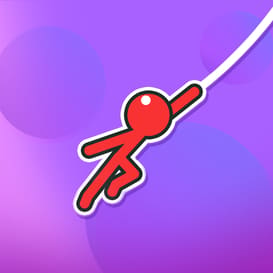
Stickman Hook







| Rating | 4.4 / 5 (15,670 votes) |
| Played | 156,700 times |
| Developer | MadBox |
| Released | 2018-09-20 |
| Platform | Desktop, Mobile, Tablet |
| Technology | HTML5 |
| Category | Casual Games |
What is Stickman Hook?
Stickman Hook is a physics-based swinging game where you launch a stickman from anchor point to anchor point, building momentum with each swing to reach the finish line. Think Spider-Man but with worse aim and a lot more crashing into walls. The concept is dead simple: click to grab the nearest hook, swing, release at the right moment to fly through the air, and grab the next one. String enough swings together and you reach the goal. Miss a hook and you faceplant into the ground.
What makes Stickman Hook special is how the physics feel. The swinging has genuine weight to it. Your stickman builds speed as you arc through a swing, and the release angle determines whether you sail gracefully to the next hook or nosedive into the floor. There's a satisfying learning curve where your first few attempts are chaotic disasters, but within 10 minutes you're chaining together swings that feel smooth and intentional. That progression from flailing to flowing is the whole appeal.
The game features dozens of levels across different environments, each one introducing new layouts and hook placements that force you to adjust your timing. Some levels are straightforward point-A-to-point-B swings. Others throw in moving platforms, multiple routes, and bonus collectibles that require precise swinging to reach. It's easy to finish most levels, but finishing them quickly and cleanly takes real skill.
How to Play Stickman Hook
Each level starts with your stickman standing on a platform. Above and ahead of you are anchor points — small dots that you can latch onto. When you click (or press space), your stickman extends a line to the nearest anchor and begins swinging from it. The swing follows realistic physics: you accelerate as you drop lower in the arc and slow down as you rise. Release at the right moment and you fly off in whatever direction your momentum is carrying you.
The trick is managing that momentum. If you release too early in a swing, you don't build enough speed to reach the next anchor. Release too late and you're moving in the wrong direction — your stickman launches backward or straight into the ground instead of forward toward the goal. The sweet spot is usually just past the bottom of the arc, when you're moving fast and still angled toward where you want to go.
As levels progress, the anchor placements get trickier. Some require multiple swings in quick succession with no room for error. Others force you to swing wide to build speed before launching toward a distant anchor. A few levels have you swinging through tight corridors where one wrong release angle sends you into a wall. The variety keeps the game from feeling repetitive, even though the core mechanic never changes.
Controls
- Click / Space / Tap: Grab the nearest anchor point and start swinging
- Release click / key / tap: Let go and fly through the air
- That's the entire control scheme
The simplicity is what makes it work. One button does everything. The depth comes from timing — when you grab, how long you hold, and when you let go. Two players using the exact same controls can have wildly different results based purely on timing.
Tips and Tricks
Release at the Right Moment, Not the Obvious One
Most new players release when they're at the highest point of their swing because it feels like that gives the most distance. It usually doesn't. The best release point depends on where the next anchor is, but in most cases you want to let go just after the bottom of the arc when you have maximum speed and your trajectory is still pointing forward. If you wait until you're at the top, you've lost momentum and you're moving too vertically. Think of it like a skateboard halfpipe — you don't launch from the top, you launch from the transition.
Build Momentum with Extra Swings
Sometimes the direct path to the finish requires more speed than a single swing can give you. In those cases, it's worth doing an extra swing or two to build up speed before making your final launch. Swing wide on the first anchor, let yourself drop to build speed, catch a second anchor, and use that extra velocity to launch toward the goal. It feels slower, but it's much more reliable than trying to force a low-speed jump across a big gap.
Use the Walls
Your stickman bounces off walls. This isn't a bug — it's a legitimate mechanic that you can use to redirect yourself. If you release from a swing at a bad angle, you can sometimes bounce off a nearby wall to correct your trajectory. Advanced players even use intentional wall bounces to reach anchors or collectibles that are off the main path. Don't panic if you hit a wall. Sometimes it actually helps.
Don't Grab Every Anchor
Just because an anchor is there doesn't mean you have to use it. Some levels have anchors placed specifically to throw off your rhythm if you grab them automatically. If you're already flying at a good angle and the next anchor would force you to change direction, skip it and keep your momentum. Learning which anchors to grab and which to ignore is a big part of clearing levels efficiently.
Games Like Stickman Hook
If the physics-based swinging and momentum gameplay of Stickman Hook clicked with you, these games scratch a similar itch:
- Geometry Dash — A rhythm-based platformer with the same "easy to learn, impossible to master" appeal. The obstacle patterns are fixed, so memorization and timing are everything.
- Slope — Steer a ball down an increasingly steep slope. Different mechanics, same "how did I not see that coming" feeling when you crash.
- Angry Birds — Launch birds at structures using angle and power. The physics-based trajectory planning shares DNA with Stickman Hook's momentum management.
You May Also Like
Discuss Stickman Hook
0 commentsLoading comments...